

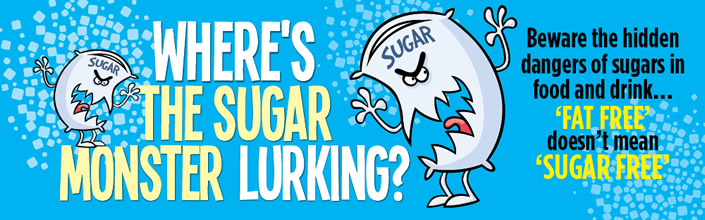
Most of us know that sugar should be consumed in moderation – however, sugars hidden in many foods and drinks means we consume more sugar than is healthy for us. Find out more…
 The facts about sugar Most adults and children in the UK eat too much sugar. Find out more about the dangers of excess sugar and how best to cut down your intake.
Sugars occur naturally in foods such as fruit and milk, but we don't need to cut down on these types of sugars.
Sugars are also added to a wide range of foods, such as sweets, cakes, biscuits, chocolate, and some fizzy drinks and juice drinks. These are the sugary foods that we should cut down on.
Why cut down on sugars?
Evidence from the National Diet and Nutrition Survey shows that most adults and children eat more sugar than is recommended as part of a healthy balanced diet.
Many foods that contain added sugars (and often have few other nutrients) are also high in energy, which is measured in either kilojoules (kJ) or calories (kcal). Eating these foods often can contribute to you becoming overweight.
Being overweight can increase your risk of health conditions such as:
To eat a healthy, balanced diet, we should eat these types of foods only occasionally, and get the majority of our calories from other kinds of foods such as starchy foods and fruits and vegetables. Learn more in A balanced diet.
Sugary foods and drinks can also cause tooth decay, especially if you eat them between meals. The longer the sugary food is in contact with the teeth, the more damage it can cause.
The sugars found naturally in whole fruit are less likely to cause tooth decay because the sugars are contained within the structure of the fruit. But when fruit is juiced or blended, the sugars are released. Once released, these sugars can damage teeth, especially if fruit juice is drunk frequently. Even unsweetened fruit juice is sugary, so try to drink no more than one glass (about 150ml) of fruit juice each day.
Fruit juice is still a healthy choice, and counts as one of your recommended daily five portions of fruit and vegetables. But it is best to drink fruit juice at mealtimes in order to minimise damage to your teeth.
Tips to cut down on sugars
For a healthy, balanced diet, cut down on foods and drinks containing added sugars.
These tips can help you cut down:
- Instead of sugary fizzy drinks and juice drinks, go for water or unsweetened fruit juice (remember to dilute these for children to further reduce the sugar).
- If you like fizzy drinks, try diluting fruit juice with sparkling water.
- Swap cakes or biscuits for a currant bun, scone or some malt loaf with low-fat spread.
- If you take sugar in hot drinks or add sugar to your breakfast cereal, gradually reduce the amount until you can cut it out altogether.
- Rather than spreading jam, marmalade, syrup, treacle or honey on your toast, try a low-fat spread, sliced banana or low-fat cream cheese instead.
- Check nutrition labels to help you pick the foods with less added sugar, or go for the low-sugar version.
- Try halving the sugar you use in your recipes – it works for most things except jam, meringues and ice cream.
- Choose tins of fruit in juice rather than syrup.
- Choose wholegrain breakfast cereals, but not those coated with sugar or honey.
Find out more ways of cutting out sugar from your diet.
Nutrition labels and sugars
Nutrition labels often tell you how much sugar a food contains. You can compare labels and choose foods that are lower in sugar.
Look for the "Carbohydrates (of which sugars)" figure in the nutrition label.
- high – over 22.5g of total sugars per 100g
- low – 5g of total sugars or less per 100g
If the amount of sugars per 100g is between these figures, then that is a medium level of sugars.
The sugars figure in the nutrition label is the total amount of sugars in the food. It includes sugars from fruit and milk, as well as the sugars that have been added.
A food containing lots of fruit or milk will be a healthier choice than one that contains lots of added sugars, even if the two products contain the same total amount of sugars. You can tell if the food contains lots of added sugars by checking the ingredients list (see below).
Sometimes you will see a figure for "Carbohydrates", and not for "Carbohydrates (of which sugars)".
The "Carbohydrates" figure will also include starchy carbohydrates, so you can't use it to work out the sugar content. In this case, check the ingredients list to see if the food is high in added sugars.
Labels on the front of packaging
There are labels containing nutrition information on the front of some food packaging.
This includes labels that use red, amber and green colour-coding and advice on reference intakes (RI) of some nutrients, which can include sugar.
Labels that include colour-coding allow you to see at a glance if the food is high, medium or low in sugars.
- red = high
- amber = medium
- green = low
Some labels on the front of packaging will display the amount of sugar in the food as a proportion of the RI. RIs are guidelines about the approximate amount of particular nutrients required for a healthy diet. For more, see Food labels.
Ingredients list
You can get an idea of whether a food is high in added sugars by looking at the ingredients list. Added sugars must be included in the ingredients list, which always starts with the biggest ingredient. This means that if you see sugar near the top of the list, you know the food is likely to be high in added sugars.
Watch out for other words used to describe added sugars, such as sucrose, glucose, fructose, maltose, hydrolysed starch and invert sugar, corn syrup and honey.
For more on other food label terms, such as "no added sugar", see Food labelling terms.

 How to cut down on sugar in your dietWe Britons really do eat too much sugar: 700g of the sweet stuff a week - that’s an average of 140 teaspoons per person.
We Britons really do eat too much sugar: 700g of the sweet stuff a week – that’s an average of 140 teaspoons per person.
Our love affair with sugar can mean that many of us are getting too many calories, which is one of the causes behind our ever-expanding waistlines.
Most of us could do with eating less sugar, particularly added sugar. But many habits, especially ones we like, are so hard to kick.
Dietitian Alison Hornby says: “Identify the sources of sugar in your diet, and decide what to cut out completely and what to cut down on.
“You don’t need to cut down on sugars found in fruit or dairy products because these foods contain lots of nutrients that are good for us.
“It’s the food high in added sugar, such as fizzy drinks, which contain lots of calories but few other nutrients that we should be trying to consume less of.”
Added sugars shouldn’t make up more than 10% of the energy (calorie intake) you get from food and drink each day. That’s about 70g for men and 50g for women. Find out how much sugar is too much.
Nutrition labels tell you how much sugar a food contains. If an item’s total sugar content is over 22.5g per 100g, it is high in sugar. Anything under 5g of total sugar per 100g is low.
“Get used to reading food labels and comparing products to choose the healthier option,” says Alison.
“Watch out for other words used to describe added sugar in the ingredients list.”
There are lots of different ways added sugar can be listed on ingredients labels such as:
- sucrose
- glucose
- fructose
- maltose
- molasses
- hydrolysed starch
- invert sugar
- corn syrup
- honey
Some packaging uses a colour-coded system which makes it easy to choose foods that are lower in sugar, salt and fat. Look for more "greens" and "ambers" and fewer "reds" in your shopping basket.
Cutting down on sugar doesn’t have to mean going cold turkey.
There are lots of small changes you can make, which over the course of a day can add up and make quite a difference.
Here are some simple tips to help you gradually cut down on the amount of added sugar in your diet.
Breakfast
Many breakfast cereals are high in sugar, with some containing up to 37% in sugar. Try switching to lower sugar cereals or those with no added sugar, such as:
- plain porridge
- plain whole wheat cereal biscuits
- plain shredded whole grain pillows
Swapping a bowl of sugary breakfast cereal for plain cereal could cut out 70g of sugar (up to 22 sugar cubes) from your diet over a week.
Porridge oats are cheap and contain vitamins, minerals and fibre. Make porridge with semi-skimmed, 1% or skimmed milk, or water. If you usually add sugar, try adding a few chopped dried apricots or a sliced or mashed banana instead. Try our apple-pie porridge recipe.
For a more gradual option, you could eat sugary cereals and plain cereals on alternate days or mix both in the same bowl.
If you add sugar to your cereal, you could try adding less. Or, you could eat a smaller portion and add some chopped fruit such as a pear or banana, which is an easy way of getting some of your 5 A DAY. Read our guide to choosing healthy breakfast cereals.
If toast is your breakfast staple, try wholemeal or granary bread (which is higher in fibre than white bread) and see if you can get by with a little less of your usual spreads (jam, marmalade, honey, chocolate spread) or try sugar-free or lower-sugar options.
Main meals
If you don’t consider yourself to have a sweet tooth and avoid sugary drinks, you may still be eating more sugar than you think. Many foods that we don’t consider to be sweet contain a surprisingly large amount of sugar.
Some ready-made soups, stir-in sauces and ready meals can also be higher in sugar than you think. Some of this sugar will come from the fruit and vegetables they contain, such as tomatoes – which we don't need to cut down on – but sugar is often added for flavour. A third of an average-sized jar of pasta sauce (roughly 150g) can contain over 13g of sugar, including added sugar, the equivalent of three teaspoons of sugar.
When eating out or buying takeaways watch out for dishes that are typically high in sugar, such as sweet and sour dishes, sweet chilli dishes and some curry sauces and salads with dressings such as salad cream, which can be high in sugar.
Condiments and sauces such as ketchup can have as much as 23g of sugar in 100g – roughly half a teaspoon per serving. These foods are usually served in small quantities but if eaten every day, the sugar count can add up.
Get tips on making healthier choices when buying takeaway food and eating out.
Snacks
Healthier snack options are those without added sugar such as fruit (fresh, dried, tinned or frozen), unsalted nuts, unsalted rice cakes, oatcakes or homemade plain popcorn. For more ideas, check out these quick and easy 100 calorie snacks.
If you’re not ready to give up your favourite flavours you could start by having less. Instead of two biscuits in one sitting, try having one. If your snack has two bars, have one and share the other or save it for another day. “If you're an 'all-or-nothing' type of person, you could find something to do to take your mind off food on some days of the week,” says Alison.
When shopping, look out for lower-sugar (and lower-fat) versions of your favourite snacks. Buy smaller packs or skip the family bags and just go for the normal sized one instead.
Here are some lower-calorie substitutes for some popular snacks:
- Cereal bar – despite their healthy image, many cereal bars can be high in sugar and fat. Look out for bars that are lower in sugar, fat and salt. Or try this fruity granola bar recipe to make your own.
- Chocolate – swap for a lower-calorie hot instant chocolate drink. You can also get chocolate with coffee, and chocolate with malt varieties.
- Biscuits – swap for oatcakes, oat biscuits or unsalted rice cakes, which also provide fibre.
- Sweets – try dried fruit such as raisins, sultanas, dates, apricots or figs, which all count towards your 5 A DAY.
- Cake – swap for a plain currant bun, fruit scone or malt loaf. If you add toppings or spreads, use them sparingly or choose lower-fat and lower-sugar varieties.
Drinks
Nearly a quarter of our added sugar in our diets comes from sugary drinks such as fizzy drinks, sweetened juices, squashes and cordials. A 500ml bottle of cola contains the equivalent of 17 cubes of sugar. Try sugar-free varieties or better yet, water, lower-fat milk, or soda water with a splash of fruit juice.
If you take sugar in tea or coffee, gradually reduce the amount until you can cut it out altogether or try swapping to sweeteners instead. Try some new flavours with herbal teas or make your own with hot water and a slice of lemon or ginger.
Don’t drink all your fruit. Like fizzy drinks, fruit juice can be high in sugar. When juice is extracted from the whole fruit to make fruit juice, sugar is released and this can cause damage to our teeth.
Drinking fruit juice doesn't fill you up as much as eating fruit. It takes about two-and-a-half oranges to make a glass of juice. But a glass of juice isn't as filling as eating two-and-a-half oranges because the fibre in the fruit makes you feel fuller for longer. However, fruit juices do contain vitamins and minerals, and a 150ml glass of unsweetened 100% fruit or vegetable juice counts as one of your 5 A DAY. Remember, fruit juice only counts as a maximum of one of your 5 A DAY, even if you have more than one glass. Even unsweetened fruit juice is sugary, so try to drink no more than one glass (about 150ml) of fruit juice each day.
If the idea of switching to water feels a drastic departure, you could try flavouring it with a slice of lemon, lime or a splash of fruit juice. Watch out for the sugar content in flavoured water drinks. A 500ml glass of some brands contains 15g of sugar, the equivalent of nearly four teaspoons of sugar.
Dessert
Work out some ground rules. Do you need to have dessert every day? How about only having dessert after your evening meal, or only eating dessert on odd days of the month, or only on weekends, or only at restaurants?
Do you have to have chocolate, biscuits and cake every day? If you had this type of sugary snack less often, would you actually enjoy it more?
Less sugary desserts include fruit (fresh, frozen, dried or tinned – choose those canned in juice rather than syrup), lower-fat and sugar rice pudding and plain lower-fat yoghurt. Watch out for added sugar content. Lower fat doesn’t necessarily mean low sugar. Some lower-fat yoghurts can be sweetened with refined sugar, fruit juice concentrate, glucose and fructose syrup.
If you’re stuck between choosing two desserts at the supermarket, why not compare the labels on both packages and go for the one with the lower amount of sugar.
Nutrition labels can help you choose between products and keep a check on the amount of foods you're eating that are high in fat, salt and added sugars.
Read on or use the links below to go straight to the sections that interest you.
- Nutrition labels on the back or side of packaging
- Nutrition labels on the front of packaging
- Reference intake (RI)
- Red, amber and green colour-coding
- Ingredients list
- Food shopping tips
Most pre-packed foods have a nutrition label on the back or side of the packaging.
These labels include information on energy in kilojoules (kJ) and kilocalories (kcal), usually referred to as calories. They also include information on fat, saturates (saturated fat), carbohydrate, sugars, protein and salt. All nutrition information is provided per 100 grams and sometimes per portion of the food.
Supermarkets and food manufacturers now highlight the energy, fat, saturated fat, sugars and salt content on the front of the packaging, alongside the reference intake for each of these. You can find out more in the section on reference intake (RI) below.
You can use nutrition labels to help you choose a more balanced diet. For a balanced diet:
- cut down on fat (especially saturated fat), salt and added sugars
- base your meals on starchy foods such as potatoes, bread, pasta and rice, choosing wholegrain where possible
- eat lots of fruit and vegetables – aim for at least five portions of a variety every day
- include some protein-rich foods such as meat, fish, pulses and milk and dairy foods
You can learn more in A balanced diet.
Nutrition labels on the back or side of packaging
Nutrition labels are often displayed as a panel or grid on the back or side of packaging. For example, the image below shows the back of pack nutrition label on a loaf of white bread.
This type of label includes information on energy (kJ/kcal), fat, saturates (saturated fat), carbohydrate, sugars, protein and salt. It may also provide additional information on certain nutrients such as fibre. All nutrition information is provided per 100 grams and sometimes per portion of the food.
How do I know if a food is high in fat, saturated fat, sugar or salt?
There are guidelines to tell you if a food is high in fat, saturated fat, salt or sugar, or not. These are:
Total fat
High: more than 17.5g of fat per 100g
Low: 3g of fat or less per 100g
Saturated fat
High: more than 5g of saturated fat per 100g
Low: 1.5g of saturated fat or less per 100g
Sugars
High: more than 22.5g of total sugars per 100g
Low: 5g of total sugars or less per 100g
Salt
High: more than 1.5g of salt per 100g (or 0.6g sodium)
Low: 0.3g of salt or less per 100g (or 0.1g sodium)
For example, if you are trying to cut down on saturated fat, limit your consumption of foods that have more than 5g of saturated fat per 100g.
Some nutrition labels on the back or side of packaging also provide information about reference intake (RI). Find out more about RI below.
Nutrition labels on the front of packaging
Most of the big supermarkets and many food manufacturers also display nutritional information on the front of pre-packed food. This is very useful when you want to compare different food products at a glance.
Front-of-pack labels, such as the label in the above image, usually give a quick guide to:
- energy
- fat content
- saturated fat content
- sugar content
- salt content
These labels provide information on the number of grams of fat, saturated fat, sugars and salt, and the amount of energy (in kJ and kcal) in a serving or portion of the food. Be aware, however, that the manufacturer's idea of a portion may be different from yours.
Some front-of-pack nutrition labels also provide information about RI. Find out more below.
Reference intake (RI)
Nutrition labels can also provide information on how a particular food or drink product fits into your daily diet.
Reference intakes are guidelines about the approximate amount of particular nutrients and energy required for a healthy diet.
Find out more about adult reference intakes.
Red, amber and green colour-coding
Some front-of-pack nutrition labels use red, amber and green colour-coding.
Colour-coded nutritional information, as shown in the image above, tells you at a glance if the food has high, medium or low amounts of fat, saturated fat, sugars and salt.
- red means high
- amber means medium
- green means low
In short, the more green(s) on the label, the healthier the choice.
If you buy a food that has all or mostly green(s) on the label, you know straight away that it's a healthier choice. Amber means neither high nor low, so you can eat foods with all or mostly amber(s) on the label most of the time. But any red(s) on the label means the food is high in fat, saturated fat, salt or sugars and these are the foods we should cut down on. Try to eat these foods less often and in small amounts.
Ingredients list
Most pre-packed food products also have a list of ingredients on the packaging or on an attached label. The ingredients list can also help you work out how healthy the product is.
Ingredients are listed in order of weight, so the main ingredients in the packaged food always come first. That means that if the first few ingredients are high-fat ingredients, such as cream, butter or oil, then the food in question is a high-fat food.
Food shopping tips
You're standing in the supermarket aisle looking at two similar products, trying to decide which to choose. You want to make the healthier choice but you're in a hurry.
If you're buying ready meals, check to see if there's a nutrition label on the front of the pack, and then see how your choices stack up when it comes to the amount of energy, fat, saturated fat, sugars and salt.
If the nutrition labels use colour-coding, you will often find a mixture of red, amber and green. So, when you're choosing between similar products, try to go for more greens and ambers, and fewer reds, if you want to make a healthier choice.
But remember that even healthier ready meals may be higher in fat and energy than the homemade equivalent. If you make the meal yourself, you could save money, too. Find out more in On a budget.
Labelling terms and food safety
To find out more about food labels, including what terms such as "light/lite" and "low fat" mean, and the difference between "use by" and "best before", read Food labelling terms.
 'I weighed 70kg at age 11'Chris Bennington, 14, swapped burgers and chips for healthy alternatives and lost more than a stone.
When he was eight years old, Chris' parents divorced and he went to live with his grandmother in Mountain Ash, South Wales. "When Chris and his brother and sister came to me, I spoilt them rotten," admits grandmother Alethea Pritchard.
Chris, who has learning difficulties, wasn't overweight when he went to live with his gran, but that soon changed. "My gran let me eat whatever I wanted," he says. "I had all my favourites, like chips, cheeseburgers, pizza, sausage rolls and cakes."
By the age of 11, Chris weighed 70kg (11st).
"He was a real little tub," remembers Alethea. "And he was so lethargic, too. If we walked down to the shops, he would complain that his legs were hurting. He wasn't getting any exercise whatsoever and I became quite worried about him."
Meanwhile, Chris' friends at primary school had started teasing him for being overweight.
"It wasn't real bullying, just a bit of friendly teasing," says Alethea. "But I worried about how things would be at secondary school, especially because he has learning difficulties too. I knew I had to do something about his weight."
Alethea started giving Chris healthier meals at home, but it wasn't long before he was back on the junk food. She decided that they needed extra help with his weight loss.
Weight loss classes
"Not long after that, I found out that there was a weight-loss class nearby and they were more than happy to have him," she remembers.
"Chris was the youngest person there, so they made a big fuss of him. He loves going to class. When his weight dropped week by week, everyone would cheer him on. It was the best thing I could have done for him."
Chris thrived on the special diet devised by the weight-loss club, which gave him a taste for pasta.
"Instead of having burgers and chips after school, he started having lots of pasta and he loved it," says Alethea.
"He was just over 70kg (11st) when he joined, but after a year he'd got down to 55kg (8st 9lb). Now his weight is going up again, but that's not excess weight, it's simply because he's getting taller."
Once a chubby boy with no energy, Chris is now transformed.
"I feel much fitter and energetic now," he says. "I wasn't happy before. I knew I wanted to lose weight, but I just didn't know how.
"It wasn't easy, but I did it. Nobody calls me 'fatty' any more, which is great. I'm definitely not going to be overweight again."
 Healthy eating self-assessment (tool) Do you really know what eating healthily means? Find out whether you're a healthy eater or could improve your eating patterns. .
 Kids' food (video)Children talk about food, and life coach Debbie Lewis suggests ways to encourage your child to eat more healthily.
Back